How To Compare Options For A First Vinyl Listening Setup For A Smaller Room
A practical step-by-step guide to how to compare options for a first vinyl listening setup for a smaller room, including preparation, instructions, common issues, tips, and next steps.
How To Compare Options For A First Vinyl Listening Setup For A Smaller Room
This guide helps you compare options for a first vinyl listening setup in a smaller room. Smaller spaces have unique acoustic challenges and spatial constraints, so you need to prioritize compactness, appropriate speaker power, and room-friendly placement. We cover how to evaluate turntables, amplifiers, speakers, and accessories, focusing on your room's size and your listening habits. By following these steps, you'll make informed choices that fit your space, budget, and musical tastes, creating a satisfying vinyl experience without overwhelming your room.
Fast Answer
- Focus on compact, bookshelf-style speakers and a small amplifier that fit your room, and measure your available space before buying.
- Choose a turntable with a built-in phono preamp to simplify your setup, and place speakers at ear level away from corners to reduce boominess.
Before You Start
- Measure the dimensions of your room, including ceiling height, and note where you plan to place the turntable and speakers.
- Identify the distance from your primary listening spot to where the speakers will sit, as this affects volume needs and speaker size.
- Determine your typical music genres and listening levels, as this influences speaker type (e.g., bass-heavy vs. balanced) and amplifier power.
- Set a flexible budget range for your setup, but be ready to adjust based on what you learn about your room's needs.
Step-by-Step Instructions
Assess your room's size and acoustics
Start by measuring your room's length, width, and ceiling height. Use these dimensions to calculate the approximate floor area, which will guide your speaker size and amplifier power. For instance, a 12x14-foot room with a standard 8-foot ceiling has around 168 square feet. In such spaces, smaller bookshelf speakers with 5-inch to 6-inch woofers are often sufficient, as they deliver adequate bass without overwhelming the room. Listen for existing acoustic issues: tap the walls to see if they are hollow, note any bare windows, and check for hard floors vs. carpet. Your room's surfaces reflect or absorb sound, affecting clarity. As a practical check, clap your hands in the room to hear how much echo exists. If you hear a distinct slap, you may need soft furnishings or a rug to tame reflections. This assessment matters because placing speakers appropriately from the start prevents boominess and ensures a clearer soundstage, saving you from buying unnecessary acoustic treatment.
Decide on speaker type and size
Given a smaller room, you have two main options: bookshelf speakers or a high-quality soundbar with a subwoofer. Bookshelf speakers offer a more authentic stereo image, which is vital for vinyl listening because the format has a wide dynamic range. Choose speakers with a sealed enclosure or front-firing bass ports, as these are more forgiving when placed near walls. A sealed design, also known as acoustic suspension, provides tighter bass and reduces the 'one-note boom' common with ported speakers in small rooms. When comparing options, look at the speaker's frequency response, especially the low-end extension. A speaker that reaches 50 Hz is usually enough for most music, avoiding the need for a separate subwoofer. If you prefer deep bass for electronic or hip-hop, consider a compact subwoofer with a satellite setup. As a check, read the speaker's recommended room size: many manufacturers list this in the manual. This matters because a speaker intended for a large room will have a wide dispersion that can cause harsh reflections in a cramped space.
Evaluate amplifier or receiver options
You need an amplifier or a receiver to power your speakers and handle the turntable's signal. In a smaller room, a modest amplifier with 20 to 50 watts per channel is ample. More power does not automatically mean louder or better sound; it simply gives you more headroom before distortion. Decide whether you want a separate amplifier and speakers or a compact all-in-one stereo system. For vinyl, you must ensure the amplifier has a phono input if your turntable lacks a built-in preamp. Many modern amplifiers omit this, so you may need a separate phono preamp. Look for analogue connections like RCA inputs, and avoid amplifiers with only digital inputs. Also, check if the amplifier has a loudness contour switch, which boosts bass and treble at low volumes—a useful feature for late-night listening in small rooms. A practical check: read the amplifier's impedance rating (usually 4, 6, or 8 ohms) and match it to your speakers' impedance. Mismatched impedance can cause overheating or distortion. This matters because efficient power delivery ensures your amplifier runs cool and your speakers receive clean power, preserving the delicate details in your records.
Choose a turntable with the right features
When comparing turntables, focus on features that improve ease of use and sound fidelity for a smaller setup. A belt-drive turntable often isolates motor noise better than direct-drive, which matters in a quiet room. Look for a turntable with an adjustable counterweight, anti-skate control, and a built-in phono preamp. A built-in preamp saves space and money, but if your receiver has a good phono input, you may get better sound by using that and disabling the built-in option. The cartridge is the heart of the turntable; a moving magnet design is standard and offers good value. Check whether the turntable has a reconnectable power cord and a dust cover, which keeps clean. For a small room, a compact turntable with a smaller footprint is ideal, but avoid excessively lightweight models that may vibrate. When listening, pay attention to speed stability; audible wow and flutter indicates a poor motor. A practical check: read the turntable's signal-to-noise ratio reported in decibels. A higher number (more negative) indicates less hum and hiss. This matters because a clean signal from the turntable is the foundation of your sound, and a quiet background lets you hear the music's nuances.
Test speaker placement and room positioning
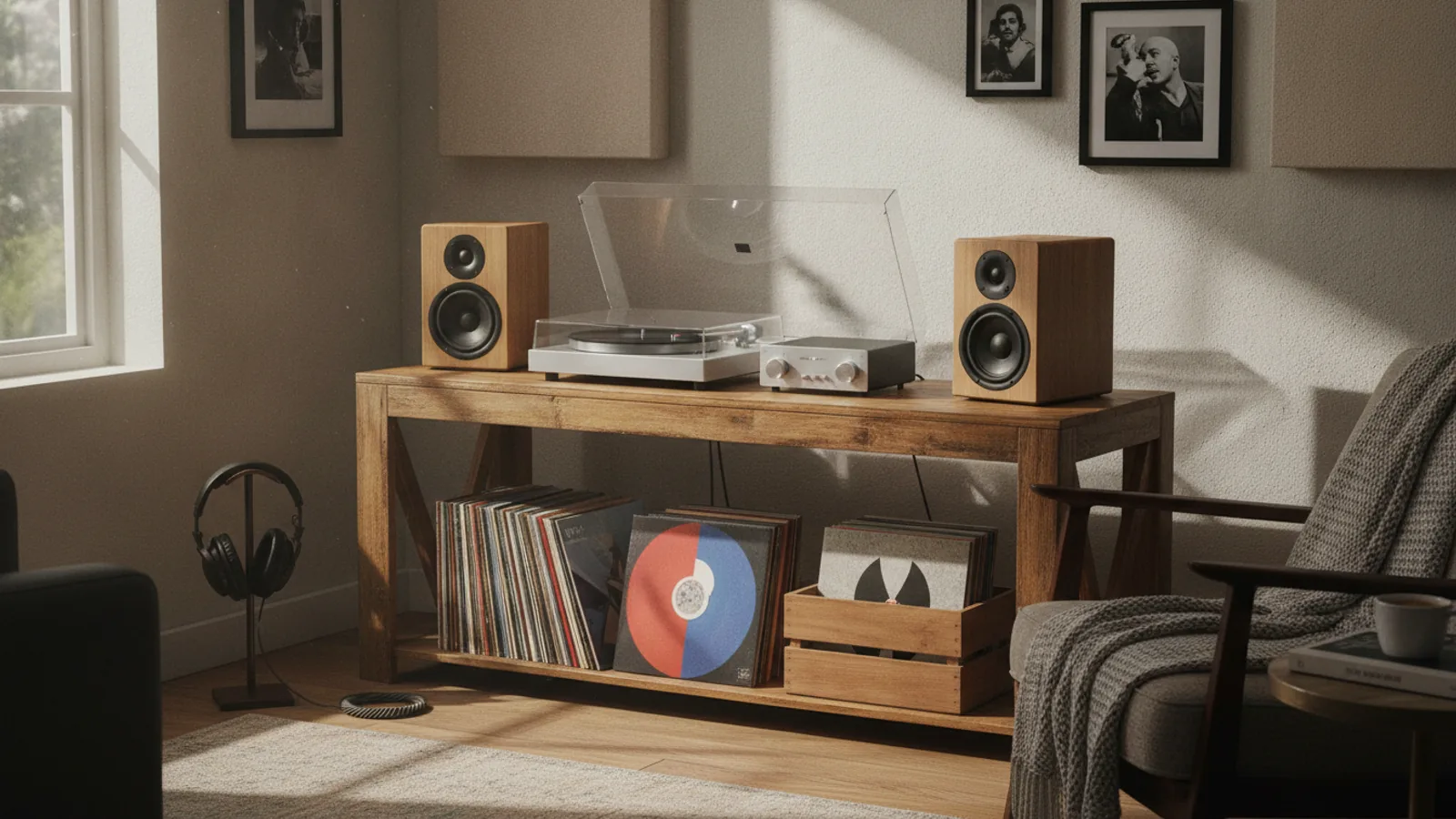
Positioning is critical in a smaller room. Start by placing your speakers on stands or shelves at ear level when you are seated. The ideal is an equilateral triangle between you and the speakers, with each speaker aimed directly at your listening spot. Pull the speakers at least 12 inches away from the back wall to avoid excessive bass, but if they are ported, maintain a distance equal to the port length plus one inch. For a room with limited space, place the speakers against the long wall opposite your main seating area. Avoid placing them in corners, which can exaggerate bass and blur stereo imaging. A practical check: walk around the room and listen for dead spots or areas where the sound becomes boomy. Adjust toe-in by turning the speakers slightly toward the center. Also, experiment with the distance between speakers; too far apart can create a hole in the center image. This matters because proper placement maximizes your speakers' performance and avoids the need for acoustic panels, which take up space and cost money.
Compare complete setups and make a decision
Now that you know what to look for, gather your shortlist of components: turntable, amplifier, speakers, and any necessary cables. Create a simple checklist for each setup: Does it fit your room's footprint? Will the amplifier drive the speakers without distortion? Does the turntable have the features you need? Consider the overall ergonomics: how easy is it to switch between vinyl and other sources? Should you use passive or powered speakers? Passive speakers require a separate amplifier, while powered speakers have built-in amplification, saving space. For a smaller room, powered speakers might simplify your setup, but you still need a preamp. If you choose passive speakers, compare amplifier power and speaker sensitivity; a higher sensitivity (greater than 90 dB) means they play louder with less power. A practical check: read the impedance range of the speakers and the amplifier's rated power at that impedance. If you are uncertain, seek out a dealer with a listening room that mimics small spaces. When you have narrowed down to two or three combinations, visit a store or borrow friends' gear to compare them in your own room. This matters because the interaction between your room and the components is unique; only by testing in context will you know which system brings the music to life.
Quick Reference
| Situation | Action | Why it helps |
|---|---|---|
| You have a smaller room and want to avoid a subwoofer but still get decent bass. | Choose bookshelf speakers with a sealed enclosure, a frequency response down to 50 Hz, and a bass reflex port that is front-facing or use stands to stay away from walls. | Sealed enclosures provide punchy bass without the port noise that often occurs when a ported speaker is too close to a wall. |
| Your amplifier lacks a phono input and your turntable has no built-in preamp. | Purchase a dedicated phono preamp, connect the turntable's RCA cables to it, then connect the preamp to any line-level input, such as Aux or CD. | The phono preamp applies the RIAA equalization and boosts the signal to line level, which is necessary for proper sound quality. |
| You hear boomy bass or unclear vocals after setting up your speakers. | Move speakers away from the back and side walls at least 12 inches, and angle them so they face your ears directly. | This reduces bass reinforcement from walls and aligns the high-frequency drivers to your ears, improving clarity and reducing muddiness. |
Common Issues
- Excessive bass boominess in a small room.: Place speakers on solid stands, pull them away from walls, and if using a subwoofer, cross it over lower (around 50-60 Hz) and reduce its volume. Consider adding a rug to dampen floor reflections.
- Feedback or rumble when the turntable is near the speakers.: Move the turntable to a separate surface that is not coupled to the same stand as the speakers. Use isolation feet under the turntable and ensure the speakers are not vibrating the floor.
- Inconsistent volume between records or during playback.: Check the stylus alignment and cartridge overhang; if uncertain, use a step-by-step alignment tool. Ensure the anti-skate is set correctly and that records are clean. Adjust tracking force according to the cartridge's recommendation.
Advanced Tips
- Experiment with treated room modes by moving speakers a few inches at a time to flatten low-frequency response, but do not obsess over measurements; trust your ears.
- If you want room correction without digital processing, try placing a small bookshelf on the back wall to diffuse reflections, but avoid excessive clutter.
- For late-night listening, use low-level equalization on your amplifier to reduce bass, as bass travels through walls and may disturb neighbors.
Final Checklist
- Measure room dimensions and listening distance to confirm speaker and amplifier sizing.
- Verify speaker impedance (4, 6, 8 ohms) matches amplifier's suitable range to avoid damage.
- Test turntable with a test record if possible, checking for stable speed and clear sound.
- Place speakers at ear level, away from corners—use stands if necessary—and enjoy your vinyl.
FAQ
Do I need a subwoofer in a smaller room?
Not necessarily. A subwoofer can conflict with the room's natural bass resonance, causing muddiness. If you choose a pair of good bookshelf speakers that extend to 45-50 Hz, you'll likely get enough bass for most music. Only add a subwoofer if you listen to music with substantial deep bass, and then use a small sealed sub with a crossover around 60 Hz to blend well.
How much power do I need for a small room?
For a typical small room (around 150-200 square feet), an amplifier with 20 to 50 watts per channel is plenty. Speakers with a sensitivity of 87 to 90 dB will reach satisfying volumes with this amount of power. More power is not harmful if you keep the volume within reasonable limits, but it is not necessary.
What is the best way to connect a turntable to a receiver without a phono input?
You can use a separate phono preamp, which usually has a ground screw and RCA outputs. Connect the turntable to the preamp, then connect the preamp to any line-level input (e.g., Aux, CD, Tape). If your receiver has a line-level input, that works. Alternatively, consider a receiver with a built-in phono stage for simplicity.