How To Plan A First Vinyl Listening Setup For A Smaller Room
A practical step-by-step guide to how to plan a first vinyl listening setup for a smaller room, including preparation, instructions, common issues, tips, and next steps.
How To Plan A First Vinyl Listening Setup For A Smaller Room
Planning a first vinyl listening setup for a smaller room requires thoughtful choices about speaker placement, furniture, and acoustic treatment. This guide walks you through assessing your space, selecting compact components, positioning speakers for best sound, managing bass, and keeping your setup organized. You’ll learn how to create a listening area that fits comfortably without sacrificing audio quality. The steps cover measuring your room, choosing appropriate gear sizes, arranging listening positions, tuning speaker placement, addressing acoustic reflections, and finalizing the layout. By the end, you’ll have a practical plan for enjoying vinyl in a smaller room with clear, balanced sound.
Fast Answer
- Prioritize speaker placement: position speakers at ear level, away from walls, and form an equilateral triangle with your listening spot.
- Include acoustic panels or rugs to tame reflections and bass buildup, which are more noticeable in compact rooms.
Before You Start
- Measure your room's dimensions along with the locations of doors, windows, and any built-in features; draw a simple floor plan.
- Decide on the primary listening position, usually a chair or sofa where you'll spend most time, and mark it on the plan.
- List your current furniture and identify what can be moved or removed to allocate space for the turntable and speakers.
- Gather a measuring tape, a pencil, and maybe a laser distance measurer to take accurate measurements.
Step-by-Step Instructions
Assess Your Room and Listening Spot
Start by measuring the room's length, width, and height, and note where doors and windows are. Also mark the exact spot where you plan to sit—this will be your primary listening position. A simple floor plan on paper helps you visualize options. In a smaller room, every inch counts. You need to know the room's shape and where furniture can go. Once you have the measurements, check that the listening position is not too close to a wall or in a direct line with a door opening, as that can cause reflections and uneven sound. This quick assessment ensures you have enough space for speakers, equipment, and comfort. It gives you a baseline for all later placement decisions, saving you from rearranging later.
Choose Compact Gear That Fits
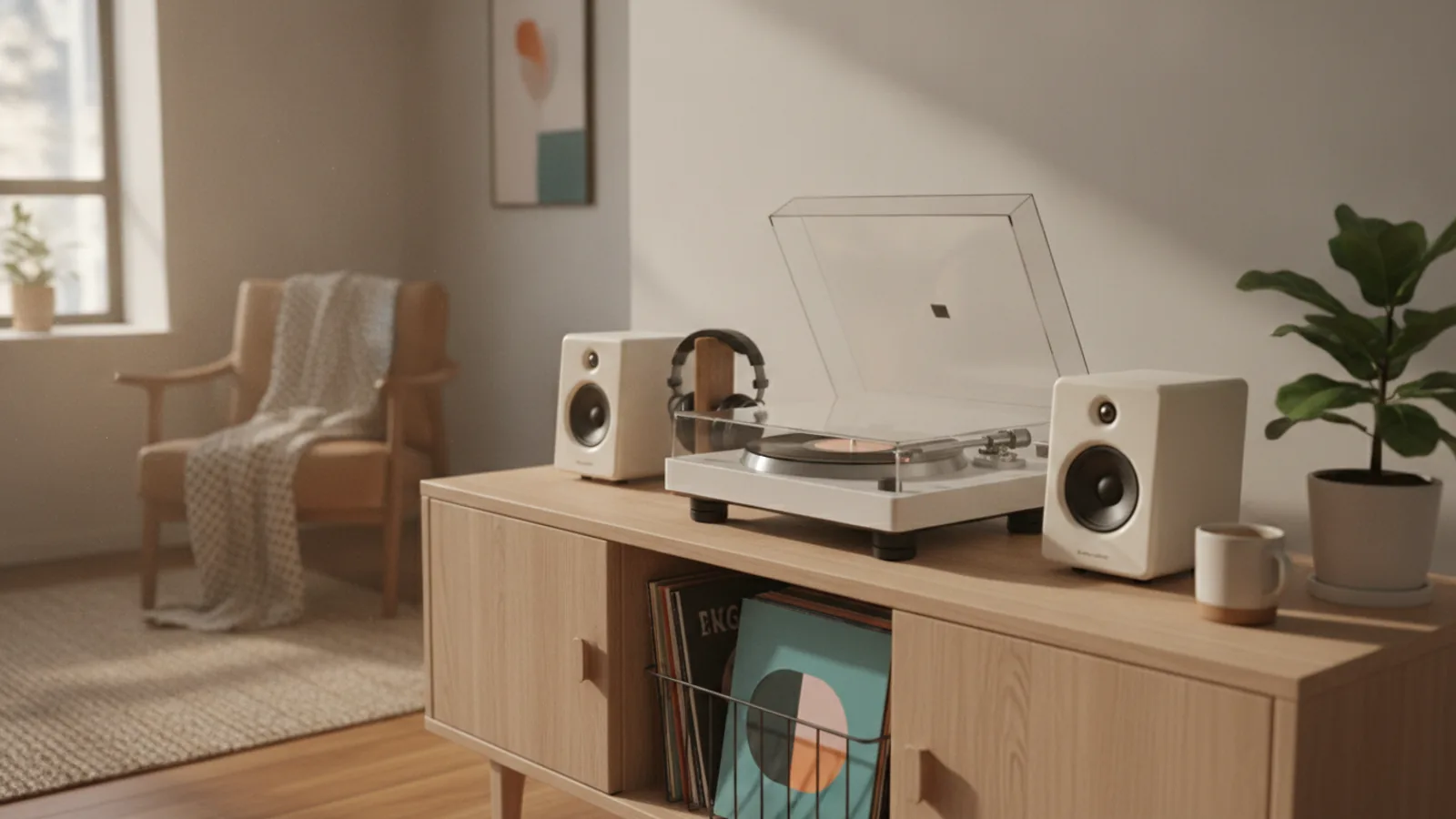
For a smaller room, pick a turntable and speakers that fit your available surface or floor space. Measure the furniture where the turntable will sit. The turntable should be on a sturdy, level, and vibration-isolated surface, preferably a dedicated stand or a thick shelf. Choose bookshelf speakers over floor-standing ones if floor space is tight. Look for speakers that can be placed on stands or wall-mounted if you lack shelf space. Consider active speakers that have built-in amplifiers to reduce the number of separate boxes. The goal is to avoid a setup that feels cramped or overcrowded. Taking dimensions and comparing with product specs before buying ensures everything fits and nothing blocks walkways or vents.
Arrange Furniture for Good Acoustics
Arrange your furniture to create a symmetrical listening triangle. Your left and right speakers and your listening position should form an equilateral triangle, with you at the apex. In a smaller room, you might need to pull speakers away from walls. Place each speaker about the same distance from you as they are from each other. For example, if you sit three feet from each speaker, they should be three feet apart. This ensures a balanced stereo image. Also, try to have a clear line of sight from each speaker to your ears, avoiding tall furniture that blocks sound. Move thick curtains or cushions to absorb reflections. This arrangement helps you hear the music as intended without echoes or uneven volume.
Position Speakers at Ear Level
Place the tweeters (the small drivers) of your speakers at the same height as your ears when you are seated in your listening spot. For bookshelf speakers on stands, this usually means the tweeter is about ear height. If you're using them on a shelf, you may need to tilt them or add small wedges to point the tweeters toward your ears. Most speakers have a specific tweet axis for optimal sound. If the tweeters are higher or lower, you'll hear a rolled-off high end, making music dull. Checking this is simple: sit in your spot and listen—if the sound seems not crisp, adjust the angle. This small alignment dramatically improves clarity and detail.
Manage Bass with Placement and Treatment
Smaller rooms often suffer from boomy bass because low frequencies build up in corners. To reduce this, keep speakers at least a foot away from side walls and two feet from the back wall. If you must place them near a wall, adjust the bass controls on your amplifier or receiver, if available. Additionally, place soft furniture like curtains, rugs, and bookshelves to absorb excess bass. A thick rug on a hard floor can kill a 5-gallon echo. Test different positions by playing a bass-heavy record and moving the speakers an inch at a time. The goal is to have bass that is even and not overwhelming. This careful placement ensures your music doesn't sound like a drum solo in a closet.
Finalize Layout and Tidy the Cables
Once the locations are set, secure all cables neatly. Run speaker wires along the floor or wall using cable clips or a cable raceway to avoid tripping hazards and keep a clean look. Make sure there are no loops of wire near the turntable that could induce hum. Check that the turntable is on a stable, level surface and that the speakers are not vibrating from the same platform. Finally, sit in your listening spot and play a record you know well. Listen for balance, imaging, and any distortion. Make small tweaks to toe-in angle or speaker distance if needed. This last step ensures the setup is comfortable and sounds its best for years.
Quick Reference
| Situation | Action | Why it helps |
|---|---|---|
| Speakers are too close to the back wall and bass sounds boomy. | Move each speaker a few inches forward from the wall, play a bass-heavy track, and repeat until the bass tightens. | Reducing boundary reinforcement helps prevent low-frequency build-up that muddies the sound. |
| When seated, the speakers sound bright or dull depending on your head position. | Adjust the toe-in angle of the speakers, turning them toward your ears slightly, and then listen again. | Toe-in aims the tweeters at your ears for a clear, centered stereo image without harshness. |
| You notice echoing or ringing sounds when you clap your hands in the room. | Identify the hard surfaces causing the echo and place a rug or textile panel on the first reflection point. | Absorbing reflections reduces comb filtering and makes the room's acoustics more neutral. |
Common Issues
- Turntable picks up footstep vibrations causing the needle to skip.: Place a thick isolation mat or use wall-mounted shelf for the turntable, and keep it away from speakers.
- Speakers sound thin because they are placed too low or too high.: Raise or tilt the speakers so the tweeters are at ear height, or replace stands with adjustable ones.
- One speaker sounds louder or too far to one side.: Check that both speakers are at equal distance from the listening position and that the amplifier balance control is centered.
Advanced Tips
- Use a laser level to ensure both speakers are at the exact same height and angle for a more precise stereo image.
- Add bass traps in the corners of the room behind the speakers to control the biggest low-frequency buildup.
- Experiment with speaker 'toe-out' settings—some users prefer a wider soundstage at the expense of pinpoint imaging.
Final Checklist
- Measured the room and marked the listening spot and speaker positions on the floor.
- Positioned the speakers at ear level and at the same distance from you, forming an equilateral triangle.
- Treated early reflection points and corners with rugs, panels, or furniture to reduce echoes and bass boom.
- Tidied all cables and ensured the turntable is on a stable, vibration-isolated surface.
FAQ
Is it okay to place bookshelf speakers on a shelf instead of stands?
Yes, but you may need to place them on thick pads or isolation feet to reduce vibrations. The shelf's height might also need adjustment so that the tweeters align with your ears. If the shelf is too low, tilt the speakers upward, or use small wedges. Ensure the shelf is sturdy and does not vibrate from the music. Also, allow some space behind the speakers for airflow and bass response.
How far should my ears be from the speakers in a small room?
A good guideline is to sit about 1.5 to 2 times the distance between the speakers. For example, if your speakers are 2 meters apart, sit 3 to 4 meters away. This helps create a proper stereo image. In a smaller room, you may need to sit closer to that minimal distance. Always test with a familiar album and adjust until the sound feels balanced and detailed.
What is the best way to reduce bass buildup without buying acoustic panels?
Start by spacing speakers away from corners and walls. Use thick rugs, heavy curtains, or soft furniture to absorb low frequencies. You can also move bookshelves filled with books to act as diffusers. If the bass is still boomy, try adjusting the bass controls on your amplifier or receiver. These changes can often reduce bass boom without spending on panels.