How To Plan A Home Audio System For Clear Everyday Music Listening
A practical step-by-step guide to how to plan a home audio system for clear everyday music listening, including preparation, instructions, common issues, tips, and next steps.
How To Plan A Home Audio System For Clear Everyday Music Listening
This guide helps you plan a home audio system for clear, everyday music listening. It covers assessing your room, choosing components, setting up, and fine-tuning. You'll learn to avoid common mistakes and get practical steps for a satisfying sound experience without getting lost in technical jargon.
Fast Answer
- Start with a simple stereo system: two good speakers, an amplifier, and a music source. Position speakers at ear level and form an equilateral triangle with your listening spot.
- For everyday listening, prioritize speaker placement and room treatment over expensive components. Acoustic panels or rugs can improve clarity more than upgrading gear.
Before You Start
- Measure your room dimensions and note the location of doors, windows, and large furniture. This helps decide speaker size and placement for best sound.
- Identify your main music sources: streaming services, CDs, vinyl, or your phone. This determines which components you need.
- Set a general budget range (e.g., entry-level, mid-range, high-end) to guide your choices, but be ready to adjust based on room needs.
- Gather essential tools: a tape measure, a pencil, and possibly a level. You may also need speaker stands or wall mounts.
Step-by-Step Instructions
Assess Your Room and Listening Habits
First, measure your room and sketch its layout, including doors, windows, and furniture. Note the primary listening position: where you usually sit. This is your 'sweet spot'. Consider the room's reflective surfaces—bare walls, tile floors, and large windows cause sound to bounce, creating echo and reducing clarity. Also think about how you listen: do you need loud volume for parties or soft background music while reading? Are you in a small bedroom or a large living room? Your answers determine speaker size and type. For example, a small room may not need floor-standing speakers; compact bookshelf speakers can be sufficient. This assessment saves you from buying gear that underperforms in your space. Practical check: mark your listening spot and measure the distance from it to where you might place speakers. Aim for an equilateral triangle, with you at one point and speakers at the other two, each side roughly equal. This ensures balanced stereo imaging.
Choose a Simple System That Fits Your Needs
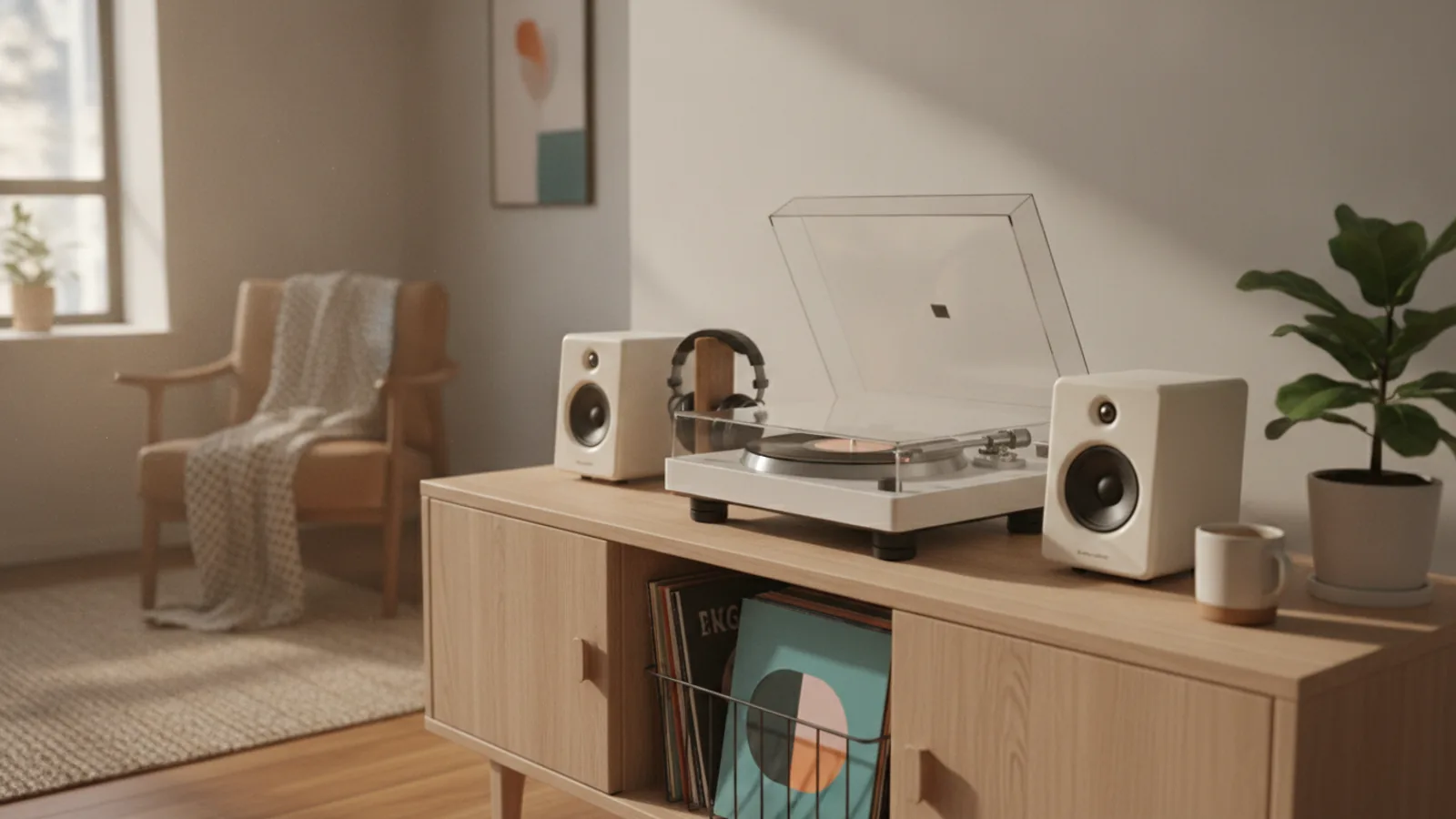
For everyday music listening, a classic two-channel stereo is often the best choice: two speakers, an amplifier (or a receiver with a built-in amp), and a music source like a turntable, CD player, or a digital streamer. This simplicity keeps costs manageable and less prone to technical issues. If you prefer minimal clutter, consider an all-in-one system that combines amp and streaming. Remember, you don't need a complex surround sound setup for clear music reproduction; that's more for movies. Focus on components that match your sources. For instance, if you only stream music, a simple amplifier with Bluetooth or Wi-Fi is sufficient. If you have a turntable, your amp must have a phono input (or you need a separate phono preamp). Do you need a subwoofer? For most popular music, full-range bookshelf speakers can handle bass well enough. Practical check: list your intended sources and ensure the amplifier or receiver has enough inputs (at least as many sources). If you plan to expand, leave spare inputs.
Match Speakers to Your Room Size and Amp Power
Next, select speakers that suit your room. Larger rooms with high ceilings allow for floor-standing speakers, but small to medium rooms often work better with bookshelf speakers on stands. Pay attention to speaker sensitivity: this is a measure of how loud they play with a given amount of power. Higher sensitivity (e.g., 90 dB or more) means they require less power to produce the same volume. Match speaker power rating with your amplifier's output. If your amp is too weak, you may get distortion at moderate volumes; too powerful and you risk damaging the speakers. A general rule is to choose speakers that are at least as powerful as the amp's output per channel. Also, consider the speaker's impedance, typically 4 or 8 ohms. Ensure your amplifier can handle the impedance of your speakers. Practical check: read both your amp's and speakers' specifications—look for recommended power and impedance ranges. If you are unsure, pick a moderate amp (around 30-50 watts per channel) and bookshelf speakers with matching power handling.
Place Speakers for an Even Stereo Image
Position your speakers carefully. Place them along the shortest wall, if possible, so that sound travels across the room's length rather than width. This reduces early reflections from side walls. Don't place them directly against the wall or in corners, as this overemphasizes bass and muddies mids. Typically, keep bookshelf speakers 1-2 feet from the back wall, and floor-standing speakers a bit more. Angle them slightly toward your listening spot (toe-in) so that you form an equilateral triangle with you and the speakers. The tweeters (if present) should be at ear level when you are seated. If you place speakers on stands, adjust their height. For wall-mounting, tilt them down if they are above ear level. Practical check: play a track with a centered vocal, then move your head side to side. The voice should stay anchored in the middle. If it jumps, adjust speaker angles.
Wire Everything and Set Initial Levels
Connect your components using quality cables, but don't overspend on exotic wires. Make secure connections: ensure all plugs are fully inserted and screws tightened. When connecting speaker wire, observe polarity: usually red to red (positive) and black to black (negative). If you reverse polarity, you'll get weak bass and a vague soundstage. After all connections are made, turn on the system with the volume at its lowest setting. Gradually increase volume to a comfortable listening level. Balance the left-right control so that the sound seems to come from a point between the speakers. If you have a subwoofer, set its crossover frequency (typically around 80 Hz) and phase control according to its manual. Some amps have a 'loudness' button—you may want to turn it off for casual listening as it boosts bass and treble artificially. Practical check: play a mono track (like an old AM radio recording) and sit in the center; the sound should appear from a single point, not from each speaker separately.
Tune the Sound to Your Room and Preference
Now, fine-tune the sound. Begin with your amplifier's tone controls set to flat (zero treble and bass). Play a variety of music you know well—vocals, jazz, pop, classical. Listen for issues like harsh highs, boomy bass, or a 'veiled' midrange. Adjust the tone controls slightly to compensate. If you have an equalizer, make small adjustments: a slight cut in the 200-300 Hz range often reduces muddiness, while a gentle boost around 3 kHz can enhance clarity. However, be conservative; too many adjustments can ruin the sound. If possible, use the 'speaker placement' method first before reaching for EQ. Sometimes moving speakers an inch or adding a rug improves clarity more than EQ. If you have a subwoofer, adjust its volume so that bass integrates seamlessly with the main speakers, not overpowering. Practical check: listen at different times of the day; voice or acoustic guitar tracks reveal tonal balance. If vocals sound nasal or honky, there's often a midrange bump—try adjusting that.
Quick Reference
| Situation | Action | Why it helps |
|---|---|---|
| You are unsure whether to buy a subwoofer. | First, without a subwoofer, listen to bass-heavy music like hip-hop or electronic. If you feel the bass is lacking at your normal seating position, then consider adding a subwoofer, but place it near a wall (not a corner) and cross it over at 80 Hz. | Many bookshelf speakers produce adequate bass for most music. A subwoofer can cause boomy, uneven bass if not properly set, so it's better to start without and add only if needed. |
| Your speakers sound bright and fatiguing at low volumes. | Check if your amplifier has a 'loudness' control; if so, enable it. If not, slightly increase the bass tone control and decrease the treble by a notch. Also, consider moving the speakers slightly away from the side walls. | At low volumes, human ears are less sensitive to bass and treble. Brightness at low volume may be due to frequency response anomalies. Tone adjustments can compensate for the perceived imbalance. |
| You hear a hollow or distant sound when sitting in your usual spot. | Move your speakers closer together, and toe them in more so they directly face your ears. Also, try pulling them a few inches away from the back wall to reduce boundary reflections. | A hollow or distant sound often indicates poor stereo imaging, often caused by speakers being too far apart or angled incorrectly. Toeing-in aims the high-frequency drivers directly at you, sharpening the image. |
Common Issues
- Boomy or one-noted bass that varies as you move around the room.: Move your speakers away from walls and corners (at least 1-2 feet). Place them symmetrically in the room. If possible, add a thick rug on a reflective floor to absorb some bass reflection. Also, ensure the speakers are on stable stands or shelves, not on hollow furniture.
- Muffled vocals or lack of clarity in the midrange.: Check that no furniture blocks the speaker drivers. Pull speakers forward so they are at least 1 foot from the back wall. If the room is very soft (thick curtains, carpet), add some reflective surfaces like a glass shelf or hardboard to reduce excess absorption. Also, try a slight boost in the 2-4 kHz range on your EQ if available.
- One speaker sounds louder or treble-heavy compared to the other.: First, swap the speakers or cables between left and right channels to see if the problem follows the speaker or the channel. If it's the speaker, check the tweeter for damage. If it's the channel, check your amplifier balance and input connections. Ensure the speaker wire polarity is correct on both sides.
Advanced Tips
- Consider using room correction software or apps that measure your room's frequency response via a microphone and apply digital filters. Many amplifiers have built-in room correction; if not, some streaming apps include simple EQ.
- Experiment with speaker toe-in: start with a 30-degree angle toward your listening position, then adjust tiny amounts to find the 'sweet spot' where the soundstage appears broad and centered.
- Use high-quality lossless music files or streaming on the highest quality setting. Compressed files can reduce high-frequency detail and sound slightly veiled, especially at higher volumes.
Final Checklist
- You have identified your main listening positions and measured the distances between you and your speakers.
- All connections are secure, and speaker wire polarity is correct (positive to positive, negative to negative).
- Speakers are placed away from large reflective surfaces and are level with your ears, with toe-in adjusted for a clear central image.
- You have listened to a variety of music, adjusted tone controls to taste, and confirmed you can listen for extended periods without ear fatigue.
FAQ
What is the ideal distance between speakers and the listening position?
Start with an equilateral triangle where the distance between the speakers is roughly the same as the distance from each speaker to your ears. This approach typically provides a balanced stereo image. For example, if your speakers are 8 feet apart, you should sit about 8 feet away from each. You can adjust based on your room, but this rule of thumb helps.
Should I place my speakers on the floor or on stands?
Place bookshelf speakers on sturdy stands so the tweeters are at ear level. Floor-standing speakers are designed to sit on the floor, but they may cast a large bass floor and need some space from walls. Avoid placing speakers on hollow shelves or cabinets, which can vibrate and add coloration. Stands isolate the speaker and improve clarity.
Can I use a TV or computer as the music source for my stereo?
Yes, you can connect a TV's audio output to your amplifier if it has the appropriate input (like an auxiliary or optical). For a computer, you can use a USB or cable to connect to a digital-to-analog converter (DAC) and then to your amp, or use a simple cable from your headphone jack. Ensure you select the correct input on your amplifier.