What To Check Before Choosing A Turntable And Speaker Setup That Is Easy To Live With
A practical step-by-step guide to what to check before choosing a turntable and speaker setup that is easy to live with, including preparation, instructions, common issues, tips, and next steps.
What To Check Before Choosing A Turntable And Speaker Setup That Is Easy To Live With
This guide helps you choose a turntable and speaker setup that fits easily into your daily life. It focuses on practical checks like room size, speaker placement, built-in phono stages, connectivity options, and maintenance needs. By following these steps, you'll avoid common mistakes and enjoy reliable, low-fuss vinyl listening.
Fast Answer
- Check your room's size and layout first, because it dictates the speaker size and placement that will work best without causing clutter or awkward positioning.
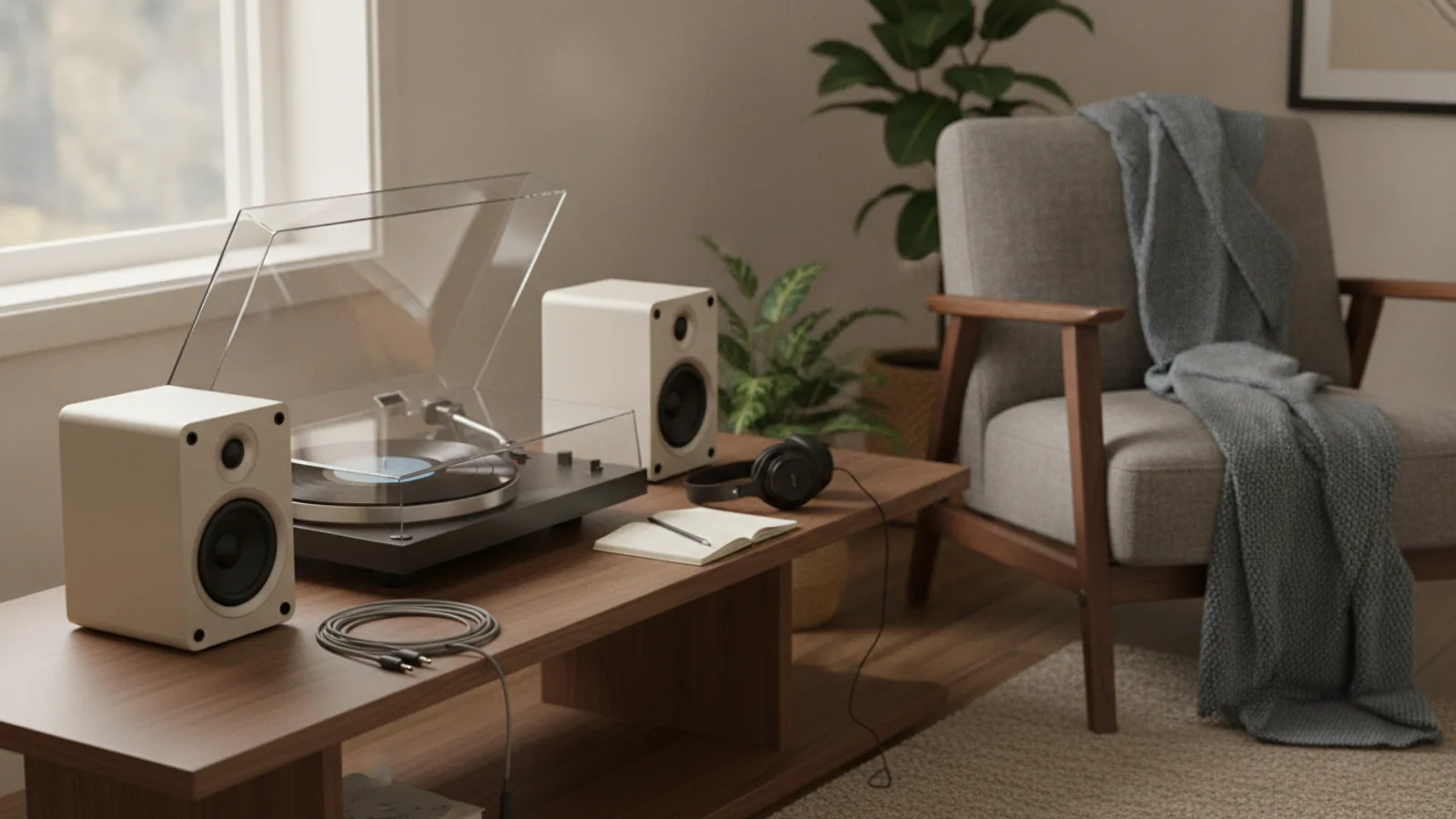
- Look for a turntable with a built-in phono stage and a pair of powered speakers with multiple inputs. This setup is simple to connect and requires no extra boxes or complex wiring.
Before You Start
- Measure the space where you plan to put the turntable and speakers, noting the distance between them and any walls or corners that could affect sound.
- Decide on a budget range before you start shopping, and remember that you might need to spend separately for speaker stands or isolation pads to get the best sound.
- Think about how you will use the system: for focused listening, background music, or both. This affects the speaker type and turntable features you need.
- Check what audio sources you already own, like CDs, Bluetooth devices, or a computer, to ensure the speakers have the right inputs for your needs.
Step-by-Step Instructions
Measure Your Room and Plan Speaker Placement
First, measure the length and width of the room where you will use the turntable. This will tell you how much space you have for speakers and where to place them. For a small room, bookshelf speakers might be fine, but a large room will need bigger floor-standing speakers to fill the space. Draw a simple floor plan and mark where you usually sit. Place the speakers so they form an equilateral triangle with the listening spot, with each speaker angled toward you. Also, make sure there is at least a foot of space between the speakers and walls to avoid bass buildup. Measure the distance from the planned speaker location to the nearest power outlet, because you will need to run power cords safely. This planning step is essential because it prevents you from buying speakers that are too big for the room or that cannot be placed correctly.
Choose Speakers That Fit Your Room and Listening Habits
Now that you know your room size, decide between powered (active) speakers and passive speakers. Powered speakers have built-in amplifiers, so they are simpler to set up because you do not need a separate amplifier. For an easy-to-live-with system, powered speakers are often the best choice because they reduce the number of components and cables. Look for powered speakers that have a volume knob on the front or a remote control, so you do not have to get up to adjust the sound. If you prefer to use a separate amplifier or receiver, you might choose passive speakers, but this adds more boxes and cables to manage. Think about how loudly you like to listen and whether you want deep bass. Smaller speakers may not produce enough bass for your taste, so consider whether you would need a subwoofer later. This choice matters because it directly affects the simplicity of your setup and how satisfied you are with the sound in your specific room.
Select a Turntable with a Built-in Phono Stage
Most modern turntables have a built-in phono preamp, but some do not. A phono stage boosts the turntable's faint signal to a level that standard speakers or amplifiers can use. If your turntable lacks one, you will need to buy a separate phono preamp, adding an extra box and cables. Check the turntable's specifications to see if it has a built-in phono stage and a line-level output. If it does, you can connect it directly to powered speakers or any amplifier's aux input. Also, look for a switch that lets you toggle between phono and line output. This feature is useful if you later decide to use a separate preamp or a receiver with a phono input. Make sure the turntable has a user-replaceable cartridge, because you will eventually need to replace the stylus. This step simplifies your setup and saves you from buying extra gear, making your system easier to use.
Check Connectivity Options for All Your Devices
Examine the inputs available on the speakers you plan to buy. Most powered speakers have at least a pair of RCA inputs and maybe a 3.5mm auxiliary input. If you want to listen to music from your phone or computer wirelessly, look for speakers with Bluetooth built in. For a versatile setup, choose speakers that have at least two or three inputs, such as one RCA, one auxiliary, and one optical. This variety lets you connect your turntable to one input and your TV or computer to another. Also, check whether the turntable has a USB output, which some models do for ripping vinyl to a computer. While this is not essential for everyday listening, it might be useful if you want to digitize your records. Having the right connections means you can actually use the system without needing adapters or constantly swapping cables, which keeps your living space tidy and your listening hassle-free.
Consider the Turntable's Ease of Setup and Use
Some turntables come pre-assembled with the cartridge aligned and the tonearm balanced, while others require you to set up the tonearm counterweight and anti-skate yourself. For an easy-to-live-with system, choose a turntable that is fully set up out of the box or offers a simple setup guide. Look for turntables with an auto-stop feature, which lifts the tonearm at the end of the record, so you do not have to jump up to stop the platter. Some have auto-start as well, meaning you just press a button to play. A manual turntable gives you more control but requires your attention for every record. Also, check the speed control - some turntables have a switch for 33 and 45 RPM, while others require you to pull off the platter to change speeds. The easier the setup and operation, the more you will actually use the turntable, so this step is key to a low-fuss experience.
Plan for Placement and Vibration Isolation
On a stable, level surface, place the turntable away from speakers and foot traffic. Vibrations from speakers or walking can cause the stylus to jump or produce a rumble. To reduce vibrations, you can buy isolation feet or a platform under the turntable. Place the speakers on stands or shelves that are sturdy. If you must put the turntable on the same piece of furniture as the speakers, put isolation pads under the speakers or turntable. Also, check the surface is level because a tilted turntable can cause record wear and speed issues. Use a small bubble level if you are unsure. This step is important because even a high-quality setup can sound bad if the turntable shakes or is not level. Taking care of placement ensures your records are played accurately and your equipment lasts longer.
Quick Reference
| Situation | Action | Why it helps |
|---|---|---|
| Room is under 150 square feet and you want minimal clutter. | Choose a pair of compact powered bookshelf speakers and place them on stands or at ear level on a shelf. | Smaller speakers fit better in tight spaces and do not need to produce deep bass, which is fine for smaller rooms. |
| You have a separate amplifier or receiver with a phono input. | Choose a turntable without a built-in phono stage and connect it to the amp's dedicated phono input. | Using the amp's phono stage avoids duplicate amplification and often yields better sound quality. |
| You want to listen to both records and Bluetooth audio from your phone. | Get powered speakers with Bluetooth and a turntable with a line-level output, then connect the turntable to the speakers via RCA. | This setup allows you to switch between vinyl and wireless streaming without extra hardware. |
Common Issues
- Speakers are too close to the wall, causing boomy bass.: Move the speakers at least 20-30 cm away from the wall, or plug the bass ports with foam if they are front-facing.
- The turntable plays a hum or buzz even when not touching the needle.: Check the ground wire connection from the turntable to the amplifier or powered speakers; if there is no ground terminal, ensure the turntable and speakers are plugged into the same power strip.
- The needle skips when you walk near the turntable.: Place the turntable on a dedicated, stable piece of furniture or add isolation feet. Also, avoid placing it on hollow shelves or near subwoofers.
Advanced Tips
- Consider a turntable with a built-in phono stage that has a switch to bypass it, so you can upgrade to a separate phono preamp later without replacing the turntable.
- For a cleaner look, route all cables through the furniture or along the back edges, and use cable ties that are easy to remove.
- Invest in a stylus cleaning brush and use it every few records; a clean stylus improves sound and extends record life.
Final Checklist
- Room measured and speaker placement planned for an equilateral triangle with at least a foot from walls.
- Speakers chosen are powered or passive with appropriate inputs for your devices, and a phono stage built-in or available.
- Turntable selected with automatic features if desired, and set up with level surface and anti-vibration measures.
- All connections made securely, and you have tested the system with a record to check for hum or distortion.
FAQ
What is the simplest way to connect a turntable to speakers?
The simplest way is to use powered speakers and a turntable with a built-in phono stage. Connect the turntable's line-level output directly to the speakers' RCA or auxiliary input with a standard stereo cable. No extra amplifier is needed.
Can I use a turntable with any speaker?
No, turntables need a phono stage to boost their signal. If your speakers have a built-in phono input or if the turntable has a phono stage, you can connect them directly. Otherwise, you need a separate phono preamp between the turntable and the speakers.
How much space do I need between speakers and walls?
Generally, place speakers at least 20-30 centimeters away from walls to reduce excessive bass. However, the exact distance can vary with speaker design, so experiment by moving them a few centimeters at a time and listening for balanced sound.