Common Mistakes When Setting Up A First Vinyl Listening Setup For A Smaller Room
A practical step-by-step guide to common mistakes when setting up a first vinyl listening setup for a smaller room, including preparation, instructions, common issues, tips, and next steps.
Common Mistakes When Setting Up A First Vinyl Listening Setup For A Smaller Room
Setting up a first vinyl listening setup in a smaller room can be a rewarding experience, but it often comes with pitfalls that can compromise sound quality. This guide highlights common mistakes such as poor speaker placement, ignoring room acoustics, and neglecting proper phono preamplification. It provides practical, step-by-step advice to help you avoid these errors, optimize your space, and enjoy a rich, balanced sound without needing extensive technical knowledge or expensive equipment. By following the planning, setup, and troubleshooting tips in this guide, you'll be able to create a credible vinyl listening corner that brings your records to life while fitting comfortably in a compact living space.
Fast Answer
- Start by placing your speakers away from walls and corners, forming an equilateral triangle with your listening position, to avoid booming bass and muddied mids. Experiment with toe-in to fine-tune the stereo image.
- Invest in a good phono preamp if your turntable doesn't have one built in, and always set the tracking force and anti-skate according to your cartridge's specifications. These adjustments directly impact sound quality and record wear.
Before You Start
- Measure your room's dimensions and identify the primary listening spot, typically where you'll sit. This helps in positioning speakers and minimizing reflections.
- Gather basic tools: a spirit level, a tape measure, and a digital scale for setting tracking force accurately. These ensure precise setup.
- Choose a sturdy, level table or stand that can isolate the turntable from vibrations, such as one with isolation feet or a heavy base.
- Check your turntable's manual for its built-in phono stage and cartridge specifications. If it doesn't have a built-in preamp, plan to purchase one.
Step-by-Step Instructions
Position Your Speakers for Optimal Sound
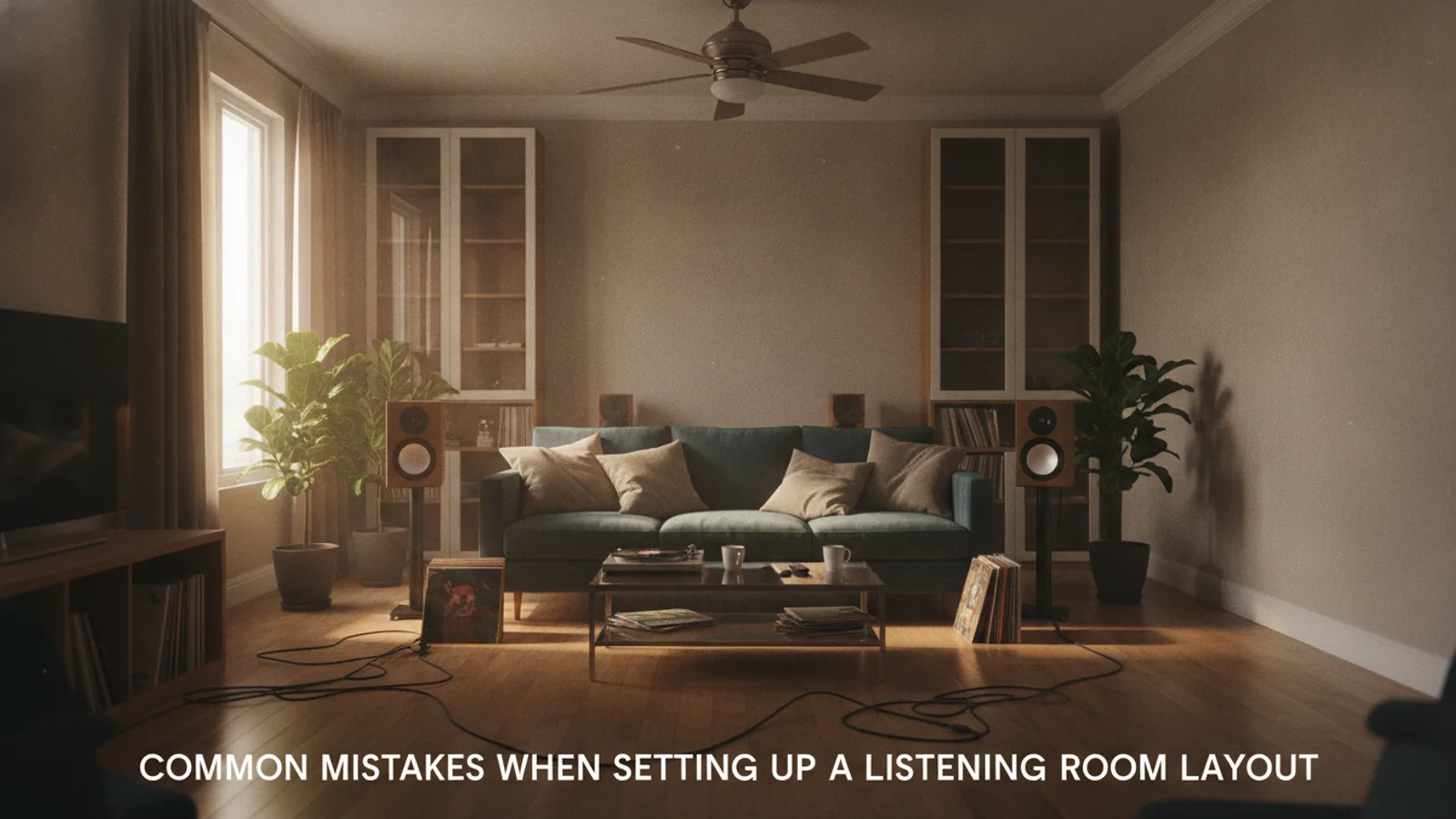
In a smaller room, speaker placement is crucial to avoid overpowering bass and unclear mids. Start by placing your speakers along the longer wall if possible, which reduces room mode interference. Position them at least 2 feet away from the back wall and 3 feet from side walls to minimize boundary bass boost. Then, form an equilateral triangle with the speakers and your listening position, with each speaker angled inward (toe-in) about 30 degrees. Ensure the tweeters are at ear height when you're seated. A practical check: sit in your listening spot and play a vocal-heavy track; the voice should appear centered and focused, not vague or spread out. This placement ensures you get a proper stereo image and balanced frequency response, which is essential in a small room where reflections can easily smear the sound.
Set Up a Sturdy, Isolated Turntable Surface
Your turntable must be isolated from vibrations to prevent feedback, especially with speakers nearby. Place it on a dedicated, heavy, and rigid table or stand that doesn't wobble. If you must use a bookshelf, ensure it's securely anchored and not prone to resonance. After placing the turntable, use a spirit level to confirm it's perfectly horizontal, both front-to-back and side-to-side; an uneven turntable can cause tracking errors and uneven stylus wear. A practical check: lightly press on the table near the turntable; if any movement is transmitted, add isolation feet or a marble slab under the turntable. This minimizes external vibrations that can cause low-frequency feedback and muddy the sound, preserving the clarity of your records.
Ensure Proper Phono Preamplification
Your turntable's output is very low and lacks equalization, so it must go through a phono preamp before your amplifier's AUX or line-level input. First, check if your turntable has a built-in phono stage; if not, you'll need to buy a separate one. If your turntable has both, use the built-in for convenience but note that an external preamp often offers better sound. When connecting, use short, high-quality RCA cables and ensure a solid ground connection to avoid hum. A practical check: play a record with the turntable connected to the PHONO input if available; if the sound is very faint or thin, you're likely bypassing the preamp. Proper preamplification restores the RIAA equalization curve, ensuring balanced bass and treble, and raises the signal to line level for your amplifier.
Set Tracking Force and Anti-Skate Correctly
The stylus (needle) needs the right amount of downward force (tracking force) and a side force (anti-skate) to stay in the groove without wearing out your records unevenly. First, consult your cartridge's manual for the recommended tracking force range, typically between 1.5 and 2.5 grams. Use a digital scale to set the counterweight precisely; don't rely on guesswork. After setting the tracking force, adjust the anti-skate to the same value (usually equal to the tracking force). A practical check: play a record that has a quiet section and listen for any distortion on the right channel only, which might indicate too little anti-skate. Proper settings ensure that the stylus tracks the groove accurately, reducing distortion and preventing excessive wear on both your stylus and vinyl.
Clean Your Records and Stylua Before Playing
Even new records can have dust and static that cause pops and crackles, and a dirty stylus degrades sound quality. Before each play, use a carbon fiber brush to lightly sweep the record from center to edge in a circular motion. Also, check the stylus visually; if you see a buildup of dust, use a stylus brush or a specialized cleaning gel to carefully remove it, brushing from back to front. A practical check: play a record you've just cleaned; if you still hear surface noise, the issue might be in the grooves, so consider a wet cleaning with a record cleaning solution and microfiber cloth. Regular cleaning prevents dust from embedding into the vinyl, reducing background hiss and preserving the fidelity of your records.
Tune Your Room Acoustics with Simple Moves
Small rooms often suffer from flutter echoes and standing waves that color the sound. To tame these, introduce soft furnishings like carpets, curtains, or a fabric-covered sofa, which absorb high-frequency reflections. Place bookshelves (with staggered books) along walls to break up flat surfaces and diffuse sound. If you can, add a thick rug between you and the speakers to reduce reflections from the floor. A practical check: clap your hands and listen for a lingering echo; if you hear one, you need more absorption. These adjustments prevent 'boxy' or 'honky' sound, making your vinyl playback more natural and enjoyable. You don't need professional panels; everyday items work well in a small space.
Quick Reference
| Situation | Action | Why it helps |
|---|---|---|
| Speakers are too close to the back wall causing booming bass. | Move the speakers at least 2 feet away from the back wall, and if that's not possible, angle them slightly inward to reduce boundary effects. | This reduces bass buildup from wall reflections, preventing one-note boom and improving overall clarity. |
| Turntable picks up vibrations when you walk near it. | Place the turntable on a heavy, stable platform and isolate it with rubber or sorbothane feet; avoid placing it on hollow shelves. | Isolating the turntable prevents structural vibrations from reaching the stylus, ensuring faithful tracking and preventing feedback. |
| Hum is audible even when no music is playing. | Check that the turntable's ground wire is securely connected to the grounding screw on your preamp or receiver, and use shielded RCA cables. | A proper ground and shielded cables reduce electromagnetic interference and eliminate hum, proving essential for quiet playback. |
Common Issues
- Low volume and overly bright or thin sound: You are likely missing a phono preamp. Connect your turntable to a phono preamp or use the PHONO input on your amplifier, ensuring it's not set to AUX. Also, check that the preamp is powered and correctly connected.
- Distortion on one channel, especially during loud passages: This is often due to incorrect anti-skate or tracking force. Reset the tracking force with a scale and set anti-skate to match. Also, clean the stylus and ensure it's not worn.
- Turntable skips on new records: Check that the tracking force is set at the maximum recommended for your cartridge, and ensure the turntable is level. If skipping persists, examine the stylus for damage or debris; cleaning it often resolves the issue.
Advanced Tips
- Consider using a dedicated power conditioner or at least a surge protector to filter AC line noise, which can cause a subtle hiss and reduce dynamic range.
- Place a heavy book or a specially designed record clamp on the center spindle when playing warped records; this can flatten them slightly and improve tracking.
- Try using the mono button on your amplifier when playing older mono records; it eliminates the 'stereo separation buzz' that many mono pressings have when played in stereo.
Final Checklist
- Speaker placement set: at least 2 feet from walls, forming an equilateral triangle with listening spot, with tweeters at ear height.
- Turntable is level, isolated from vibrations, and not sharing a surface with speakers.
- Phono preamp is connected correctly, with appropriate gain and grounding.
- Tracking force and anti-skate are set within the cartridge's recommended range, and stylus is clean.
FAQ
Do I need an external phono preamp if my turntable has one built-in?
Not necessarily, but you might get better sound with an external preamp because built-in circuits are often basic. If you're on a budget, the built-in preamp will work fine. To test, compare the built-in output to an external preamp (you can borrow one or buy a budget model). If you notice more detail, deeper bass, and cleaner highs, consider upgrading.
How can I reduce record static in a dry room?
Use a carbon fiber brush before each play, and occasionally use a record cleaning solution that contains an anti-static agent. You can also store records in anti-static inner sleeves and keep the environment moderately humidified (around 45-50% relative humidity). Avoid synthetic carpets and use a humidifier if needed.
What is the ideal speaker height for a small room?
Ideally, the tweeters should be at ear height when you're seated in your listening position. If your speakers are bookshelf models, you can place them on stands or sturdy shelves. If they're too high, tilt them downward slightly. The goal is to have the soundstage at ear level for a natural and immersive experience.